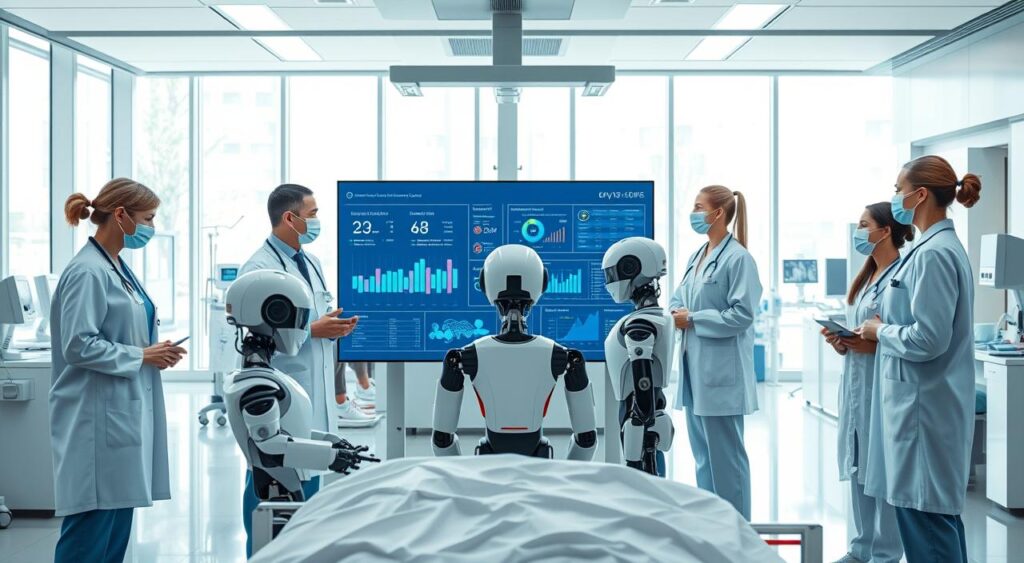
Artificial Intelligence (AI) has changed how we deal with pictures and videos. Now, machines can understand them very well.
AI in image and video recognition is big in many fields. It’s used in security, healthcare, and entertainment.
With AI algorithms, companies can do things on their own. This makes decisions better and helps customers more.
Using image and video recognition is getting common. It’s changing how we look at and understand pictures and videos.
Key Takeaways
- AI makes image and video recognition better.
- Artificial intelligence automates tasks and improves decision-making.
- Image and video recognition have various industry applications.
- AI algorithms improve accuracy in visual data analysis.
- The technology is transforming industries worldwide.
The Evolution of AI in Visual Recognition Technology
AI in visual recognition has grown a lot. It has changed from simple image work to understanding complex visuals.
From Early Computer Vision to Modern AI Systems
Old computer vision systems couldn’t handle complex images. Pioneering work in the 1960s and 1970s started the path to today’s systems.
Pioneering Work in the 1960s and 1970s
The first systems did only basic image tasks. Researchers started to make computers understand visual data.
The Neural Network Revolution
The arrival of neural networks was a big change. These networks let computers learn and get better at recognizing images.
Key Milestones in AI Visual Recognition Development
There have been many important steps in AI visual recognition.
ImageNet Competition and Its Impact
The ImageNet Competition was key. It gave a big dataset for training and checking AI models.
Recent Breakthroughs in Visual AI
New discoveries have made AI in visual recognition even better. Now, it helps in many areas.
Fundamental Technologies Behind AI Image Recognition
The heart of AI image recognition is in smart tech. It lets machines see and understand pictures. This is thanks to complex algorithms and special designs.
Convolutional Neural Networks Explained
Convolutional Neural Networks (CNNs) are key in AI image recognition. They work well with pictures because of their special design.
How CNNs Mimic Human Visual Processing
CNNs are like our brains when we see. They find edges, shapes, and more. This helps them see pictures like we do.
Layer Architecture and Function
CNNs have many layers. Each one does a different job. They help find and classify pictures.
Deep Learning Architectures for Visual Processing
Many deep learning designs help with seeing pictures. They make AI image recognition better.
Popular Models: ResNet, Inception, and YOLO
Models like ResNet, Inception, and YOLO (You Only Look Once) are big deals. They make pictures easier to recognize.
Training Data Requirements for Effective Recognition
Good AI image recognition needs lots of training data. The better the data, the better the AI gets.
- Big datasets teach AI many things.
- Diverse data helps AI work well in different situations.
By using these key techs, AI image recognition keeps getting better. It helps us see and understand pictures more clearly and quickly.
How AI Processes and Interprets Visual Data
AI has changed many fields, like healthcare and entertainment. It does this by understanding and analyzing pictures and videos. This is thanks to special technologies.
Feature Extraction and Pattern Recognition
Feature extraction is key in AI’s work. It finds important parts in images, like edges and shapes. Pattern recognition then looks at these parts to find patterns or objects.
Object Detection vs. Image Classification
Object detection and image classification are different tasks. Image classification puts an image into a category. Object detection finds and spots objects in an image, giving details about where they are.
Semantic Segmentation Techniques
Semantic segmentation breaks down an image into parts. It labels each pixel. This helps understand complex scenes better.
Instance vs. Semantic Segmentation
There are two main types of segmentation. Semantic segmentation groups pixels by class. Instance segmentation tells each pixel apart, even if they’re the same class. Knowing the difference is key for precise object identification.
Real-world Applications of Segmentation
Segmentation is used in many ways. For example, in autonomous vehicles for detecting lanes and obstacles. In medical imaging, it helps find tumors and study body parts. These uses show how vital segmentation is in AI’s work.
Real-time Video Analysis: AI’s Growing Capabilities
AI is changing how we see and use videos. It makes old things better and opens new doors in many fields.
Challenges of Processing Moving Images
Handling moving images is hard. It deals with different speeds, hidden objects, and complex movements. AI needs to be smart to track and understand these well.
Frame-by-Frame Analysis vs. Temporal Understanding
There are two main ways to analyze videos. One looks at each frame alone. The other looks at how frames change over time.
Motion Tracking Algorithms
Motion tracking is key to seeing how objects move in videos. It uses methods like optical flow and object detection.
Activity Recognition in Video Streams
Activity recognition spots certain actions in videos. It’s very useful for watching over places and keeping things safe.
Computational Requirements for Real-time Processing
Real-time video analysis needs lots of computer power. Good algorithms and strong computers are needed to do it fast and right. Experts say, “It takes a lot of computer power to process videos in real time. We need better computers and software.”
As AI gets better, video analysis will too. We’ll see new uses and better ways to use it.
Commercial Applications of AI Visual Recognition
AI visual recognition is changing how businesses work. It’s used in many areas, making things better for companies and their customers.
Retail and E-commerce Use Cases
In retail and e-commerce, AI helps a lot. It makes shopping better and makes things run smoother.
Visual Search and Product Recognition
Visual search lets you find things by pictures, not words. It’s great for online shopping. You can find similar items easily.
Visual search makes online shopping better by being easy and personal.
Customer Behavior Analysis
AI watches how people act in stores. It looks at who walks by, how long they stay, and what they touch. This helps stores arrange things better.
Retailers can now make better choices to make more sales and happy customers.
Entertainment and Media Applications
The entertainment world also uses AI visual recognition. It helps with keeping content right and making special effects.
Content Moderation and Filtering
AI finds and removes bad content online. This keeps places safe and respectful. AI makes content moderation better by doing it fast.
Special Effects and Post-production
AI helps make movies and videos better. It does things like remove objects and fix colors. This saves time and makes things look more real.
AI changes post-production for the better, making effects more amazing.
Manufacturing and Quality Control Systems
AI is also big in making things and checking quality. It’s great for finding and fixing problems.
Defect Detection and Classification
AI finds problems in products early. This stops bad products from being sold. It makes things better and saves money.
AI makes finding problems better, helping quality control a lot.
As AI gets better, it will help more areas. This will lead to new ideas and better ways of doing things.
Security and Surveillance: AI-Powered Monitoring Systems
AI is changing how we watch and protect places. It makes systems better at finding and stopping threats.
Facial Recognition Technologies
Facial recognition helps find people fast. It’s used at events and at borders.
Implementation in Public Spaces
Facial recognition is used in cities and places where lots of people go. It helps keep everyone safe.
Philippine National ID System and Biometrics
The Philippine ID uses facial recognition. It makes it easier to get government services and keeps the country safe.
Behavior Analysis and Anomaly Detection
AI watches how people act. It spots odd behavior. This stops problems before they start.
Crowd Monitoring in Urban Areas
In cities, AI watches crowds. It finds strange actions. This keeps people safe at big gatherings.
Privacy Concerns and Ethical Considerations
AI surveillance helps a lot, but it also worries people about privacy. Personal data, like faces, must be kept safe.
Philippine Data Privacy Laws and Regulations
The Philippines has rules for data. These laws help make sure AI is used right and respects privacy.
In short, AI makes watching and protecting better. But we must also protect privacy and act ethically.
Healthcare Innovations Through AI Visual Analysis
AI visual analysis is changing healthcare a lot. It makes doctors better at diagnosing and caring for patients. It also makes work easier for doctors.
Medical Imaging Diagnostics
Medical imaging has gotten much better with AI. AI algorithms can analyze medical images like X-rays and CT scans very well. This helps find diseases early.
X-ray and CT Scan Analysis
AI systems can analyze X-ray and CT scan images fast. They find problems like fractures or tumors better than doctors can.
Early Disease Detection Applications
AI helps find diseases like cancer early. This means doctors can treat patients sooner. It can make patients feel better faster.
Patient Monitoring Applications
AI helps watch over patients better. Remote patient monitoring systems track important signs. They catch problems early, so doctors can act fast.
Surgical Assistance Systems
AI is helping in surgery too. Surgical robots assisted by AI do complex surgeries more accurately. This makes surgery safer.
I.A. News: Latest Breakthroughs in Visual Recognition Technology
Visual recognition technology is getting better fast. This is thanks to new AI research. It’s making image and video analysis more accurate. It’s also opening up new uses in many fields.
Recent Research Developments
AI research has made big strides in visual recognition. Two key areas are Multimodal AI Systems and Zero-shot and Few-shot Learning.
Multimodal AI Systems
Multimodal AI systems can handle many types of information. This includes images, text, and audio. It makes AI systems smarter and more flexible.
Zero-shot and Few-shot Learning
These techniques let AI models learn quickly. They can recognize things with very little training. This is great for places where data is hard to get.
Emerging Startups and Industry Leaders in the Philippines
The Philippines is a hot spot for AI innovation. Many startups and leaders are working on visual recognition tech.
Local AI Initiatives and Innovations
Local efforts are creating AI solutions for Philippine needs. This includes agriculture and healthcare. These innovations will help the economy grow and improve life quality.
Technology Forecasts and Future Directions
Visual recognition technology will change many sectors in the Philippines.
Impact on Philippine Industries and Society
Advanced visual recognition tech will boost productivity and safety. It will also open up new business chances. But, it also brings up privacy, job loss, and AI literacy concerns.
Challenges and Limitations in Current AI Visual Systems
AI visual systems have made big steps forward. But, they still face many challenges. These issues affect how well they work and how reliable they are. They deal with things like accuracy, bias, and how fast they can process information.
Accuracy and False Positive Issues
One big worry is how accurate AI visual systems are. False positives can cause them to make wrong choices. Things like the environment and culture can also change how well they do.
Environmental and Cultural Factors Affecting Performance
Changes in lighting, setting, and culture can really mess with AI’s accuracy. For example, a system trained on one area might not do well in another. This is because of the different cultural or environmental settings.
Bias and Fairness Concerns
Bias in AI systems is a big problem. How the data is made is key to fairness. If the data doesn’t show all kinds of people, the system might not work the same for everyone.
Representation in Training Data
It’s important to make sure the training data shows all kinds of people and situations. This means using diverse data and checking it often. It helps keep the system fair and accurate.
Computational and Energy Efficiency Challenges
AI visual systems need a lot of computing power. This can be a big problem for energy use. Making AI that’s good for the planet is now more important than ever.
Sustainable AI Development
It’s key to make AI that’s not just good but also saves energy. We need to make the algorithms and hardware better. This way, AI can be both accurate and kind to the environment.
Conclusion: The Future Landscape of AI in Visual Recognition
The future of AI in visual recognition looks very bright. New research and development are making big changes. We will see AI used in many areas, like healthcare and entertainment.
AI systems are getting better at recognizing images. This means businesses can do things faster and smarter. It will change how we live and work a lot.
We will see even more cool uses of AI soon. This will help the Philippines and other places grow. The future of AI is exciting and full of possibilities.